

Frequently asked questions
Who can call stop work on a drilling rig
The rig’s SWA procedure should empower all personnel, including contractors, to raise safety concerns and stop affected work. For US offshore operations subject to SEMS, the regulation explicitly extends stop work responsibility and authority to all personnel when imminent risk or danger exists.
Who can restart work after a stop
The authority designated in the site’s procedure must approve restart after the concern has been assessed and controls verified. Under US offshore SEMS, the individual with ultimate work authority determines that imminent risk or danger is absent, with the restart decision documented as soon as practicable.
Can an AI safety camera replace stop work authority
No. A camera can support observation and alerts for configured hazards. It cannot replace a worker’s right to raise a concern, the competent assessment of conditions or the designated authority’s restart decision.
Stop work authority (SWA) gives personnel the authority to pause or refuse work when they identify an unsafe condition or an uncontrolled hazard. On a drilling rig, an effective SWA process brings the affected operation to a safe state, investigates the concern, restores controls and requires an authorized restart.
The difficult part is making SWA work during a lift, tubular transfer or shift change. A crew member may hesitate to challenge a colleague. A supervisor may acknowledge a stop without resolving its cause. An alert may reach a dashboard without reaching the equipment operator.
For rig managers and HSE teams, SWA needs a clear operating procedure, credible support from leadership and a defined path from concern to corrective action.
What does stop work authority mean on a drilling rig
SWA creates a practical opportunity to interrupt a developing exposure before it becomes an incident. It should be explained during induction and reinforced through the job safety analysis (JSA), toolbox talks and task-specific briefings. Personnel need to know how to call a stop, whom to notify and what happens next.
There is also a jurisdictional distinction. For operations subject to US Outer Continental Shelf SEMS requirements, 30 CFR 250.1930 requires all personnel to have the responsibility and authority to stop work or decline a task involving imminent risk or danger, without fear of reprisal. It also addresses safe stopping, restart decisions, documentation, JSAs and training. This is not a universal legal rule for every onshore rig or Gulf jurisdiction. Local requirements and the operator’s procedures must establish the applicable responsibilities.
The authority to raise a concern must remain distinct from the authority to restart. Under the US offshore framework, ultimate work authority requirements require a clearly identified person in charge, including across connected operations and changes of responsibility. Elsewhere, the rig’s management system must make the restart decision equally clear.
When should a drilling crew stop work
Crews should act when the conditions or controls no longer support safe execution of the task. The following are illustrative stop work authority examples, not substitutes for the rig’s lifting, well-control or emergency procedures.
Lifting and suspended loads
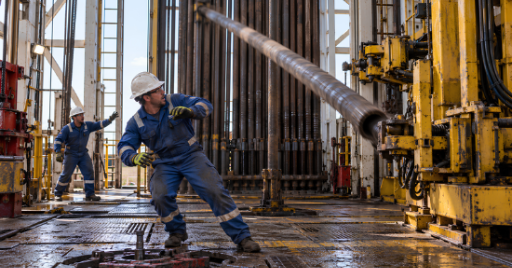
A worker enters the potential impact area of a suspended load, a load behaves unexpectedly or the agreed communication with the operator is lost. These conditions require immediate attention through the established stop signal and safe-stopping procedure. IOGP lifting and hoisting guidance emphasizes planned lifts, defined responsibilities, tested communications and keeping people clear of overhead loads. A deviation from the lift plan calls for making the operation safe and stopping the job.
Pipe handling at the V door and drill floor
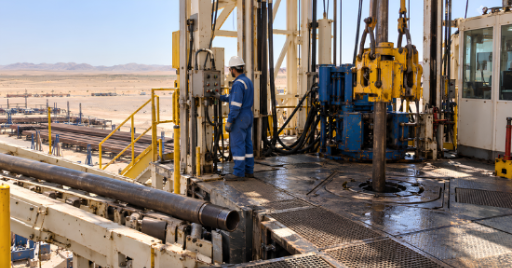
During tubular movement, a person steps between the pipe and fixed equipment, enters the elevator swing path or reaches toward a pinch point. The question is whether movement can expose someone to impact or trapping. OSHA’s drilling and tripping guidance identifies caught-between and struck-by hazards around pipe handling. Stop triggers should be discussed for the specific equipment and task, rather than relying only on painted floor markings.
Simultaneous operations and changing conditions
Simultaneous operations (SIMOPS) can create conflicts between individually planned activities. For example, a maintenance team’s access route may overlap a lifting area, or an overhead task may expose another crew below. A change in weather, visibility, personnel or equipment status can also invalidate assumptions made during the briefing. Pause the affected work and have the responsible supervisors reconcile the interfaces before proceeding.
Stopping safely matters. A stop call does not instruct an untrained observer to operate equipment or abruptly shut down a safety-critical process. The competent person controlling the operation must follow the applicable procedure to establish a safe state.
How should the stop work process work
A practical procedure should cover the following six stages. The site’s management system determines the precise responsibilities and records.
- Recognize and communicate the concern. Use the agreed signal or radio call. Identify the affected task, location and hazard as clearly as possible. Do not wait for a photograph, an AI alert or a completed report before raising an immediate concern.
- Stop and make safe. The responsible operator or person in charge brings the affected activity to a safe state. Keep personnel clear of exposure and notify other teams whose work may be affected.
- Assess the actual conditions. Involve the person who raised the concern and the relevant competent personnel. Compare the work as it is happening with the JSA, permit, lifting plan and operating procedure.
- Correct the problem. Restore or improve the necessary controls. Depending on the task, this may involve changing the sequence, repairing equipment, revising access arrangements or coordinating another work party.
- Verify and authorize restart. Check that the controls work at the point of use, brief affected personnel and obtain the designated authorization. A cleared alarm alone does not demonstrate that work is safe.
- Record and follow up. Capture the concern, action taken and restart decision in the required records. Assign outstanding actions and explain the outcome to the crew so the same exposure does not simply reappear on the next shift.
IOGP Start Work Checks offer a useful principle for the verification stage: confirm that critical safeguards are present and functioning where the work will take place. A completed form should support that conversation, not replace it.
Why does stop work authority fail in practice
Failures can occur before the stop is called, during the response or when work resumes. Reviewing each stage helps an HSE team identify what needs to change.
People expect a negative response
A worker may worry about embarrassing a colleague, delaying the crew or being viewed as inexperienced. Contractors may be uncertain whether the operator will support their intervention. OSHA’s worker participation guidance stresses that people need freedom from fear of retaliation when reporting hazards.
Supervisors should acknowledge good-faith concerns calmly and examine the conditions before judging the person. Where a concern proves unfounded, explain what made the task safe. Public criticism after a stop can undermine the next briefing’s promise that everyone is empowered to speak up.
Familiar work hides changing exposure
Repetition can make a departure from the plan feel routine. Teams may accept an obstructed view or an awkward access route because earlier jobs ended without injury. Ask what has changed and which safeguard prevents serious harm today. NIOSH guidance on fatigue also identifies impaired attention, judgment and reaction time as relevant effects. An SWA program should sit alongside fatigue management, not carry that responsibility by itself.
The message does not reach the right person
A concern raised in one work group may never reach another crew or the person controlling movement. HSE guidance on safety-critical communications emphasizes the audience, timing, communication method and language. On a rig, agree the stop signal, confirm that it is understood and make responsibility changes explicit during handover.
Restart becomes a formality
Moving a person out of a hazard zone may remove the immediate exposure without fixing why the person entered it. Was the access route unsuitable? Did the task require entry? Was the work sequence unclear? Restart reviews should address the underlying work arrangement and verify the revised controls with affected personnel.
Lessons from BSEE and IADC safety alerts
Three official reports describe work continuing despite an obstructed view, a warning about an unsafe attachment point or pipe-handling equipment meeting an obstruction.
BSEE Safety Alert 288, dated 7 June 2010, describes a fatal pipe-handling incident on a deepwater drilling unit. A rig employee acting as spotter was caught between the overhead trolley pipe handler’s lower travel assembly and a vertical support stanchion. The operator’s view of the spotter was obstructed. The investigation concluded that the operator failed to confirm an all-clear with the spotter and failed to exercise Stop Work Authority after losing sight of him. The alert recommends reviewing SWA responsibilities and identifying and communicating trolley-crane hazards.
In the BSEE investigation of the August 2012 EC-381 incident, a third-party crane rig-up worker attached his safety-harness lanyard to a boom section suspended by the platform crane. When the section moved unexpectedly, he lost his balance, fell between boom sections and sustained a compound fracture to his right arm. Two witnesses had asked him to move his lanyard to the stationary heel section. The report states that he did not follow that warning and no one exercised Stop Work Authority.
IADC Safety Alert 15-10, published on 11 November 2015, describes a stand caught behind a fingerboard latch. The hydraracker operator continued retracting its arms, building energy in the trapped stand. When the lower tailing-arm latches could no longer withstand the forces, the stand recoiled and fatally struck a crew member. IADC states that he was unaware he had placed himself in the line of fire.
Across these cases, warning signs or unsafe conditions were present, yet work continued. That does not mean every hazard was recognized: the first report describes unidentified crush points, and IADC records the injured worker’s lack of awareness.
How can AI cameras support stop work authority
Computer vision can add observations around configured, visible hazards. Veunex’s AI safety solution describes video-based risk detection and red-zone monitoring, while its drilling rig application focuses on supporting HSE teams with observations and leading indicators. These capabilities can help teams investigate exposure patterns and decide where intervention procedures need improvement.
For example, a configured alert for entry into a monitored zone may draw attention to a person near moving tubulars. A supervisor can use the operational context to assess the concern and initiate the site’s response. Reviewed footage may later help explain why the person entered the area and whether the route or work sequence should change.
Camera coverage, lighting, obstruction and configuration affect what is observable. An image alone cannot establish that every isolation is effective, a permit is valid or a concealed mechanical component is sound. A missed detection does not make a task safe. Workers must remain free to stop work without waiting for the system.
Before relying on alerts, test representative rig conditions and agree who receives each alert, how it is acknowledged and how unresolved concerns are escalated. Include crew feedback when reviewing false alarms and missed events. Explain the purpose of recording, who can access footage and how it will be used. Human responsibility for stopping, correcting and authorizing restart remains explicit throughout.
How should an HSE team measure whether SWA works
Review the quality of interventions and the control changes they produce. A low number of stop calls is ambiguous: it may reflect fewer problems, or reluctance to report them. A higher count may reflect greater participation rather than deteriorating safety.
Useful review measures include repeated exposure at the same task, the completeness of corrective actions, whether restart checks were documented and whether concerns were resolved across shifts. Ask crews whether they understand the process and feel supported when using it.
When comparing video observations, account for monitored operating hours, camera coverage and task mix. More cameras or more lifting activity can increase recorded events without an equivalent change in risk. Use these measures to investigate conditions, not to rank individuals by raw alert counts.
A short stop work authority checklist
Before starting or restarting the task, confirm:
- Everyone understands the stop signal and who controls the affected operation.
- Task hazards and SIMOPS interfaces have been reviewed with the relevant crews.
- Required safeguards have been checked at the work location.
- Changes since the briefing have been assessed.
- The concern and corrective actions are understood by affected personnel.
- The designated restart authority has verified the conditions and authorized resumption.
- Records and follow-up actions meet the site’s procedure.
Strengthen the response to hazards on your rig
Start with an activity where exposures recur or are difficult to observe, such as tubular transfer. Review how concerns are communicated, resolved and checked before restart to identify where SWA and monitoring could improve.
Note: Created with human insight and help from GenAI.
Recommended Reads
How AI Can Make Toolbox Talks More Impactful?
Toolbox Talks are essential to HSE routines, but they often lose impact when treated as routine checklists. This article explores how AI-driven tools like the
How AI Is Driving a Safer Future for Heavy Industries — Our Story with KAEFER
VEUNEX and KAEFER’s AI-integrated safety deployment improved HSE performance by 45%, strengthening real-time risk detection, team communication, and safer operations in a high-risk fabrication environment.
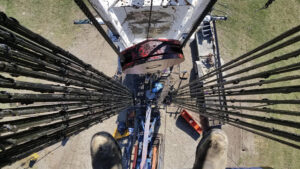
How does AI empower HSE teams to overcome Monkey Board challenges?
The latest IADC report shows the Monkey Board is one of the most dangerous places on a rig, with over 17% of incidents involving derrickmen.