
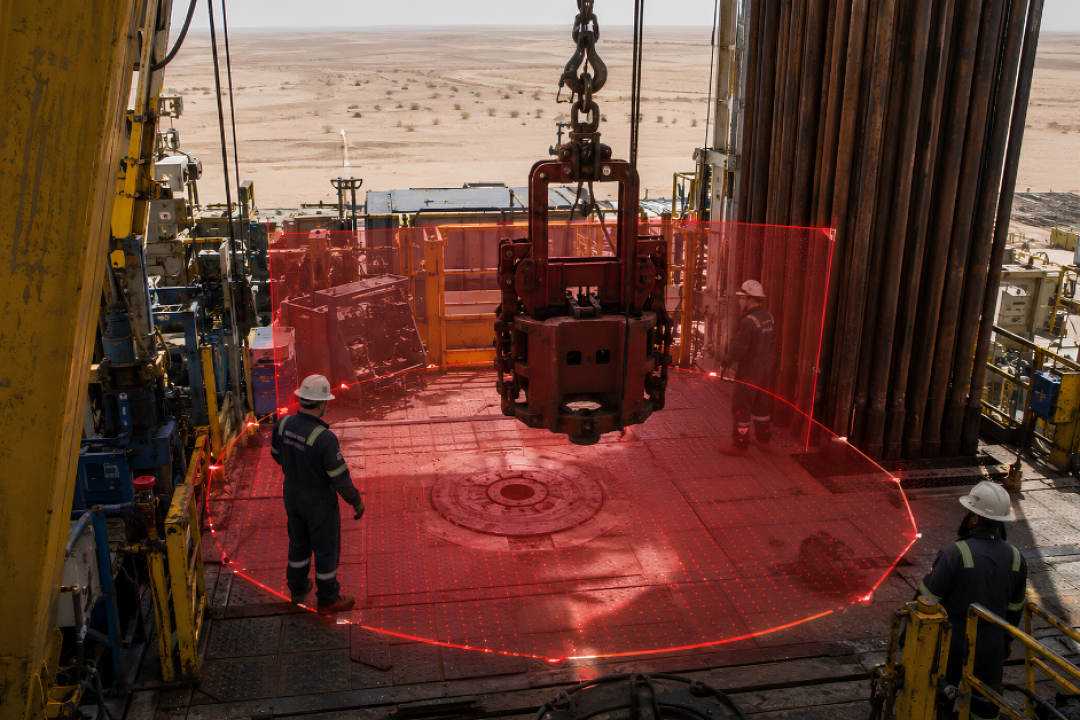
Key Questions: Elevator Line-of-Fire Risks and AI-Enabled Safety
Why are elevator Line-of-Fire risks difficult to control?
Because the hazard zone changes continuously with equipment movement, suspended loads, and personnel positioning.
What causes elevator Line-of-Fire exposure?
Common causes include equipment movement, poor communication, incomplete latching, limited visibility, and human factors.
How can AI-enabled cameras help improve safety?
It can detect unsafe positioning, identify repeated exposure, and provide evidence for better safety decisions.
How can AI support HSE and operations teams?
By creating a shared view of real operations and helping teams develop practical controls based on evidence.
On a drilling rig, the elevator is one of the most critical tools used for handling tubulars. Whether the rig uses manual, hydraulic, pneumatic, or automated systems, the elevator is directly connected to lifting, lowering, latching, releasing, and moving drill pipe, casing, tubing, and other tubulars.
Because this work involves hoisting activity, suspended tubulars, elevator links, travelling block movement, and crew members working in close proximity, the elevator can create one of the most serious line-of-fire exposures on the rig floor. The risk is more complex than a fixed red zone on a floor plan because the exposure changes as the operation changes.
Habil Saputra, HSE Professional at Saipem, describes Line-of-Fire around the elevator as “one of those silent hazards on the rig floor because exposure happens in seconds and often during routine tasks.” That field observation captures the main difficulty: the task may look familiar, but the hazard can develop very quickly.
In simple terms, the line of fire around an elevator is the area where a person could be struck, caught, crushed, or pinned if the elevator, links, tubulars, travelling block, or connected components move unexpectedly, swing, drop, open, or fail. The key issue is that this danger zone is dynamic. A position that appears safe during one step of the job may become hazardous a few seconds later when the elevator moves, the load transfers, or a tubular swings.
Main LOF risk categories around elevators
Elevator Line-of-Fire risks come from the interaction between moving equipment, suspended loads, human behaviour, and operational conditions. Understanding these key risk categories helps identify where exposure occurs and where stronger controls can be applied.
1. Human behaviour: complacency, familiarity, and tunnel vision
Elevator operations are repeated many times during drilling and tripping activities, and that repetition can quietly reduce risk perception.
From his rig and safety experience, Montrell Logan pointed out that both experienced hands and newer crew members can be exposed for different reasons: experienced personnel may become too comfortable around routine tasks, while newer workers may step too close to moving equipment in an effort to help or prove themselves.
Robert Carney, Sr Safety Specialist at Ergon Refining, Inc., adds another human-factor layer to this challenge: tunnel vision. In elevator operations, tunnel vision can develop when the crew’s attention is fixed on latching, alignment, communication, or keeping the job moving, while the movement path of the elevator or suspended tubular changes around them.
2. Dynamic hazards: the line of fire does not stay in one place
Unlike many fixed hazards, the elevator line of fire moves continuously with the elevator, links, tubulars, travelling block, and load movement. This makes the hazard difficult to manage with static awareness alone. Personnel may be outside the danger zone one moment and inside it the next because the equipment or suspended tubular has moved.
Zaur Rustamov, HSE professional at LUKOIL INTERNATIONAL GmbH, emphasized that “the greatest challenge is that the Line of Fire changes continuously during the operation.” He added that personnel may be focused on latching, stabbing, or communication and may not recognize that they have moved into the travel path of the elevator or suspended tubulars.
This is why elevator line-of-fire management cannot rely only on a general instruction to “stay clear.” The movement path needs to be understood in relation to the task, the equipment, the load, and the people working around it.
3. Equipment risks: latching, elevator selection, and retention failures
Incorrect elevator size, incomplete latch engagement, failed locking mechanisms, or weak secondary retention can quickly turn a routine elevator task into a high-potential event. If the tubular is not properly secured, it can shift, release, or fall, creating exposure not only around the elevator body but also beneath the suspended tubular and along the path of any dropped or swinging equipment.
Ahmed Al Balushi, HSE Advisor at Abraj Energy Services, highlighted that this risk can start with something as practical as selecting the wrong elevator size, especially when similar sizes are difficult to distinguish during operations. His point reinforces the importance of using measurement tools such as callipers, confirming latch engagement, and treating secondary retention checks as critical barriers. In these activities, inspections and verification steps should not become routine paperwork; they are part of preventing a dropped tubular or uncontrolled movement event.
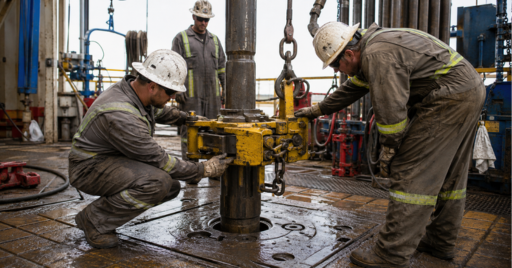
4. Unexpected movement: swinging equipment and suspended loads
Unexpected movement can come from several sources: pipe swing, vessel movement offshore, wind, misalignment, crane or driller inputs, sudden block movement, or changes in load dynamics. When this happens, the elevator, links, or tubulars can move into personnel areas within seconds.
Zaur Rustamov listed unexpected movement caused by “pipe swing, vessel movement, wind or crane/driller inputs” among the key contributing factors. These movements can create both struck-by and caught-between exposures, especially when personnel are working close to the elevator during latching, unlatching, lifting, lowering, or load transfer.
5. Communication and coordination gaps
Elevator operations depend on precise coordination between the driller, floor crew, banksman, supervisors, and anyone working near the tubular handling path. A movement that is safe only when everyone is ready can quickly become dangerous when communication is delayed, unclear, or assumed.
Zaur Rustamov highlighted poor communication between the driller and rig floor crew as one of the factors that can increase Line-of-Fire exposure, while Nweke Sunday Cyril emphasized the need for reliable communication during latching, hoisting, lowering, and releasing activities.
In practice, clear commands, radio confirmation, agreed hand signals, and positive confirmation before movement are not administrative steps; they are active controls during high-energy rig floor operations.
6. Visibility and situational awareness limitations
Blind spots, poor lighting, long stands, equipment obstruction, and simultaneous activity can make it difficult to confirm where people are standing or whether the elevator is fully latched. The driller or toolpusher may not always have a complete view of the work area, and floorhands may not always see the full movement path of the elevator and tubulars.
Habil Saputra highlighted the challenge of “blind spots” and noted that the driller and floorhands cannot always see if the elevator is fully latched, especially when conditions such as lighting, tubular condition, or equipment position limit visibility.
7. Operational pressure and task demands
The rig floor is a fast-paced environment where timing, efficiency, and operational continuity all matter. During real operations, crew members may feel they need to work close to the elevator to guide pipe, support manual handling, check alignment, lubricate components, or keep the task moving.
This is where the gap between HSE expectations and operational reality becomes important. M. Abdelhalim, Assistant Rig Manager at Noble Drilling International Ltd, pointed out that drilling contractors operate under obligations and contractual terms, which makes it essential for controls to be practical, realistic, and aligned with how the work is actually performed. Safety expectations remain critical, but they are more effective when they are designed around real rig-floor conditions rather than ideal conditions.
8. Insufficient engineering controls
Procedures, JSAs, toolbox talks, audits, and training all play an important role in managing elevator Line-of-Fire risks. However, they are less effective when the work itself still requires personnel to remain close to moving equipment or suspended tubulars. The most effective controls are those that reduce the need for human exposure by addressing the hazard at its source.
Robert Carney emphasized that while audits and JSAs remain important parts of daily safety management, teams should focus first on engineering controls. He also highlighted the importance of learning from incidents and near misses, as the difference between a near miss and a serious event can sometimes come down to timing, chance, and luck.
This approach is reinforced by Luigi Mistrali, Senior HSE Lead Auditor at Saipem, who emphasized that the strongest Line-of-Fire control is to design the operation so personnel do not need to enter the hazard zone in the first place. In practice, this means considering solutions such as automation, hands-free handling, positive latching indicators, secondary locking systems, physical separation, and improved task design wherever possible.
Practical controls that matter in real operations
The professionals who shared their experience pointed toward a layered approach. No single control is enough. The most effective strategy combines engineering controls, disciplined work practices, communication, supervision, maintenance, and continuous learning.
- Use mechanized or automated tubular handling systems where practicable to reduce hands-on exposure.
- Define and enforce Red Zones and no-go Line-of-Fire areas around elevators, suspended tubulars, and moving equipment.
- Verify correct elevator size, latch engagement, locking, and secondary retention before lifting.
- Use standardized commands, hand signals, and radio confirmation between the driller and floor crew.
- Stop movement immediately when personnel enter the danger zone or when communication is unclear.
- Assign competent supervision during critical elevator and tubular handling activities.
- Use pre-job JSA and toolbox talks that specifically address elevator Line-of-Fire exposure.
- Maintain elevators, links, lifting equipment, hydraulic components, and associated safety devices.
- Use real incidents, near misses, and behavioural observations to reinforce learning.
How AI Can Strengthen Elevator Line-of-Fire Management
AI and computer vision should not replace engineering controls, supervision, maintenance, or worker awareness. Their role is to provide an additional layer of visibility — helping teams detect exposure, understand risk patterns, and improve safety decisions using real operational evidence.
As Zaur Rustamov highlighted, AI can support elevator Line-of-Fire risk reduction by “detecting people in hazardous positions and providing real-time alerts.” Similarly, Montrell Logan described AI as “another layer of protection by recognizing unsafe positioning before an incident occurs.”
Using proven AI platforms with high detection accuracy, such as VEUNEX, which has already been deployed across more than 150 rigs, teams can add intelligence to existing CCTV systems without disrupting ongoing operations.
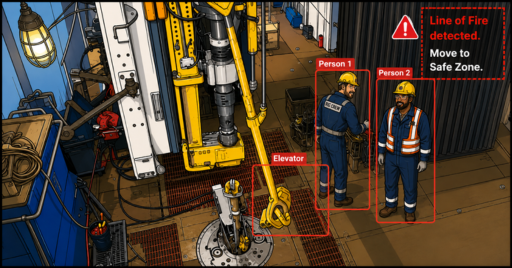
1. Real-Time Line-of-Fire Detection and Awareness
Elevator operations can change within seconds. AI-enabled cameras can help identify when personnel enter defined Line-of-Fire or Red Zone areas while moving equipment, suspended tubulars, or elevator activities are taking place.
This provides additional awareness when:
- Personnel enter restricted areas
- Workers remain close to moving equipment
- Unsafe positioning develops during operations
- Conditions change faster than manual observation can detect
By analysing existing CCTV feeds, AI can provide real-time alerts and support faster intervention by the driller, supervisor, or HSE team.
2. Identifying Risk Patterns and Behaviours
Many Line-of-Fire exposures are repeated behaviours rather than isolated events.
AI-supported analysis can help identify:
- Frequent Red Zone entry
- Tasks with repeated exposure
- Close positioning around moving equipment
- Higher-risk activities during SIMOPS
This helps teams move from identifying individual events to understanding why exposure happens and what controls can improve it.
3. Supporting HSE and Operations Alignment
A common challenge is the difference between operational reality and HSE expectations.
Operations teams may sometimes feel that working close to the elevator is necessary to complete the task, while HSE teams may see the same position as unsafe exposure.
AI-generated evidence helps both teams review:
- Where exposure occurred
- When it happened
- Which task step created the risk
- What conditions contributed
This supports more practical conversations and better-aligned controls.
4. Near-Miss Playback and Evidence-Based Learning
Learning from near misses is difficult when teams rely only on memory. AI-enabled camera can support:
- After Action Reviews (AARs)
- Toolbox talks
- Crew coaching
- Behavioural observations
- Procedure improvements
Instead of discussing hypothetical situations, teams can review real examples from their own operations and identify opportunities for improvement.
5. Human Factors and Red Zone Discipline
Elevator Line-of-Fire risks are strongly influenced by human factors, including:
- Routine and familiarity
- Complacency
- Tunnel vision
- Communication gaps
- Operational pressure
- Limited visibility
AI-supported analysis can help identify repeated exposure patterns and improve understanding of why unsafe positioning occurs.
The objective is not to replace human judgement, but to provide better information so teams can strengthen Red Zone discipline, improve work practices, and reduce repeated exposure.
8. Faster implementation using existing cameras
Many rigs already have camera coverage around critical areas. Where camera quality and positioning are suitable, AI platforms can use existing infrastructure rather than requiring major hardware replacement. This enables:
- Faster implementation
- Less operational disruption
- Lower deployment complexity
- Support for short campaigns or operations where permanent monitoring systems are not practical
The goal is to transform existing visual information into useful safety intelligence while keeping the focus on improving operational control.
Conclusion: better visibility, better conversations, better controls
Elevator Line-of-Fire risk is not only an equipment issue. It is shaped by moving machinery, suspended loads, human behaviour, communication, task design, visibility, and operational pressure. That is why it requires more than a single control or a simple instruction to stay out of the danger zone.
The strongest approach is to reduce exposure through engineering controls and better work design, supported by strong communication, supervision, maintenance, JSA, toolbox talks, Stop Work Authority, and continuous learning from near misses.
AI-supported camera can add value by making hidden exposure patterns visible, supporting real-time awareness, improving After Action Reviews, and helping HSE and operations teams work from the same evidence. The aim is not to replace experienced crews or safety professionals. It is to give them better information so they can improve standards, strengthen Red Zone discipline, and create safer ways of working.
When HSE and operations teams can see the same evidence, they can have better conversations. Better conversations lead to better controls.
Note: This article was developed through human expertise, supported by responsible use of GenAI tools. It combines field experience, HSE perspectives, and digital innovation to explore practical approaches for improving safety through AI-enabled technologies.
Recommended Reads
How AI Can Make Toolbox Talks More Impactful?
Toolbox Talks are essential to HSE routines, but they often lose impact when treated as routine checklists. This article explores how AI-driven tools like the
How AI Is Driving a Safer Future for Heavy Industries — Our Story with KAEFER
VEUNEX and KAEFER’s AI-integrated safety deployment improved HSE performance by 45%, strengthening real-time risk detection, team communication, and safer operations in a high-risk fabrication environment.
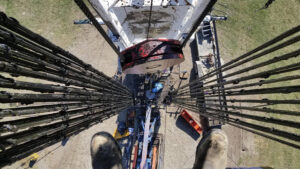
How does AI empower HSE teams to overcome Monkey Board challenges?
The latest IADC report shows the Monkey Board is one of the most dangerous places on a rig, with over 17% of incidents involving derrickmen.