
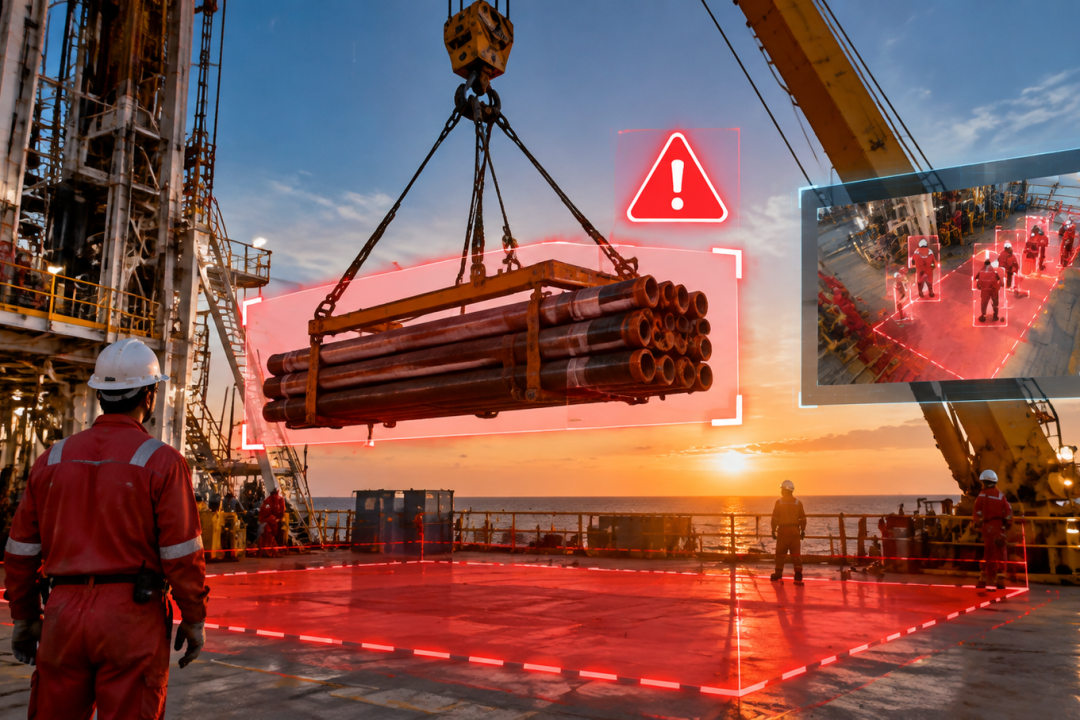
Key Questions: Suspended Load Risks and AI-Enabled Safety
What are the main suspended load risks on drilling rigs?
Suspended load risks occur during activities such as crane lifting, tubular handling, tripping operations, and material transfer. Common hazards include dropped loads, unexpected movement, equipment failure, and personnel entering red zones.
Why are suspended load risks difficult to control?
Suspended load operations are dynamic and often repeated. Over time, routine activities can lead to normalized unsafe behaviours, while supervisors cannot observe every operation happening simultaneously across the rig.
How can AI-enabled cameras help reduce suspended load risks?
AI-enabled cameras can continuously monitor lifting areas, detect personnel entering red zones, identify unsafe positioning around moving loads, and provide additional visibility for HSE teams.
How can AI support HSE teams beyond real-time detection?
AI can analyse repeated exposure patterns, near misses, and operational trends to help improve toolbox talks, risk assessments, and preventive safety actions.
Suspended loads are part of almost every drilling operation. From offshore crane activities and equipment transfers to tubular handling, catwalk operations, and tripping activities, drilling personnel routinely work around heavy equipment containing significant stored energy.
The danger of suspended loads is often associated with dropped objects; however, many incidents begin before a load ever falls. A worker entering a red zone, standing in a line-of-fire position, or approaching moving equipment during a routine task can create an exposure that may become a serious incident within seconds.
The challenge is that many of these activities are performed repeatedly. Over time, workers may become familiar with the operation and unintentionally normalize unsafe positioning.
This article brings together practical experiences from drilling and HSE professionals to explore where suspended-load risks arise, why routine exposure can become normalized, and how AI-enabled cameras can support more proactive safety management.
Why Suspended Load Risks Remain a Major Concern
Suspended load hazards exist across multiple areas of a drilling rig. Crane operations, tubular transfer, pipe handling, tripping operations, and maintenance lifting activities all involve situations where unexpected movement can expose personnel to severe consequences.
Ahmed Fayed, Drilling Fluids Engineer at Halliburton, explained that practical experience plays a major role because many hazards occur during routine operations and can become normalized over time. “Suspended-load risks are definitely an area where practical experience on the rig makes a significant difference, because many of the hazards occur during routine operations and can easily become normalized.”
The common factor across these activities is the interaction between people and moving energy. Even when equipment is functioning correctly, changing conditions, communication failures, environmental factors, or human behaviour can quickly transform a controlled operation into a hazardous situation.
Where Suspended Load Risks Occur on Drilling Rigs
Suspended-load exposure is not limited to one type of lifting activity. The severity can increase when a heavy load is elevated, when people are inside its potential drop zone, or when lifting equipment or rigging is not correctly selected, inspected, or controlled.
Tarik Mekaouche highlighted several high-risk situations, including lifting tubulars or drill pipe with a crane while personnel are nearby, BOP lifting and installation, lifting the top drive or other major rig components during rig-up and rig-down, and handling casing or drill collars with elevators or slips. He also pointed to damaged or incorrectly selected slings and shackles, uncontrolled load swing or rotation, and people guiding suspended loads by hand while standing too close to the load or a fixed structure.
The combination of a heavy load, significant height, people within the potential drop zone, and failure of lifting equipment can turn a routine lifting activity into a potentially catastrophic event. This is why exclusion and drop zones, competent lifting personnel, certified equipment, pre-use inspection, proper rigging, and controlled lifting plans remain fundamental.
Tubular Handling and Tripping Operations
Tripping operations are among the most critical activities for suspended-load exposure on a drilling rig. During these operations, heavy tubulars such as drill pipe, casing, and drill collars are continuously lifted, aligned, connected, lowered, or transferred around the well centre. The movement involves not only the tubular itself but also elevators, links, slips, lifting subs, and other components of the tubular-handling system.
Ahmed highlighted that when tubulars are picked up, aligned, stabbed, or lowered, personnel entering or remaining within the potential movement path of the tubular or elevator creates a serious red-zone exposure.
The risk is not limited to the tubular falling directly. A suspended tubular can suddenly rotate, swing, move laterally, or drop because of equipment failure, elevator unlatching, loss of control, or incorrect positioning. A moving elevator or tubular can also create a crush or struck-by hazard when its direction changes unexpectedly.
Uday Bhaskar, Sr. HSE Engineer at NSH Corporation, highlighted the risks associated with tripping tubulars and handling heavy drill collars, pointing to potential slip failure, elevator unlatching, and cable failure and the need for appropriate permit-to-work procedures and preventive controls.
Muhammad Sajjad Ashraf, Senior Drilling Engineer at ADNOC Group, similarly emphasized that tubular handling is a critical activity whether the load is lifted by crane or transferred through an automated catwalk, with a high potential for severe consequences if controls fail.
DhakshinaMoorthy (DK) Woopu Murali, Deputy General Managerat AM Green Group, shared a SIMOPS near miss in which a person performing cabling and torqueing work unintentionally entered the tubular lifting area. A tubular passed above the worker and narrowly missed him. The team responded with SIMOPS assessment and behavioural safety training, highlighting how easily simultaneous activities can create unexpected suspended-load exposure.
Catwalk Operations and Pipe Transfer Risks
Catwalk and pipe transfer activities create another important suspended-load challenge. Tubulars may roll, rotate, swing, or move unexpectedly during transfer operations.
Diego Alfonso Rosa, HSE Advisor, shared examples of serious catwalk-related incidents. In one case, a worker was positioned near tubing loads when the catwalk lifting system malfunctioned. After entering the red zone to release the tubing, a containment arm failed, causing the pipe to roll and trap the worker’s leg. Diego also described a fatal maintenance incident where a worker was underneath the catwalk when the equipment was unintentionally activated, causing the equipment to move and strike the worker.
These examples demonstrate that suspended-load risks are not limited to active lifting. Maintenance, preparation activities, and equipment positioning can also create significant exposure.
Crane Operations and Communication Challenges
Crane operations introduce several suspended-load risks, including swing radius exposure, unstable loads, unsuitable lifting equipment, improper rigging, and communication failures between lifting teams.
Ahmed Essam, HSE Professional for Heavy Lifting and Transportation at Doosan Enerbility, highlighted several common lifting challenges, including personnel standing beneath suspended loads, unstable crane conditions, improper lifting gear, and using equipment that is not suitable for the weight being lifted.
Communication is another critical factor in crane safety. Pedro Soubesse, Control Room Operator and HSE Representative at Chevron Angola, shared a unique example where a simple misunderstanding of hand signals created a dangerous situation. During a crane operation, a person passing near the crane operator used a hand gesture intended as a greeting; however, the same gesture had a different meaning in crane operations. The crane operator received conflicting signals from two people, creating the potential for an uncontrolled movement while a load was being handled.
This example demonstrates why lifting operations require clear communication protocols, designated signal persons, controlled work areas, and strict prevention of unauthorized personnel giving instructions.
The Human Challenge: Red Zone Management
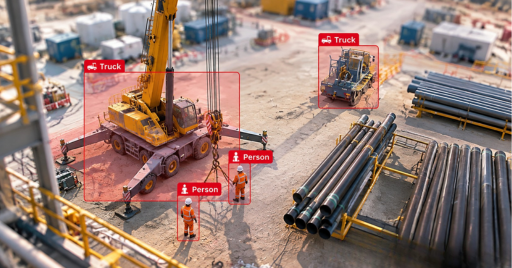
Most drilling organizations have clear procedures defining red zones and exclusion areas. However, maintaining effective control of these areas during real operations remains challenging, especially in dynamic environments where lifting activities, equipment movement, and human interaction happen simultaneously.
Brad Stump, Senior Specialist at Chevron, highlighted one common behavioural challenge: people may assume the risk has ended once the load reaches its destination. In practice, the lifting operation is not complete until all equipment movement has stopped and the load, hooks, slings, and other components are fully secured.
This means the exclusion zone must remain active until the entire lifting activity is complete. The hazard is not limited to the primary load; cranes, hooks, slings, and lifting accessories can continue to move or release stored energy even after the load appears to be in its final position.
Ahmed also highlighted behavioural normalization. When crews perform the same operation repeatedly without an incident, they may gradually become more comfortable standing closer to hazardous areas or moving equipment. As Ahmed explained, what was initially recognized as a red-zone exposure can eventually become perceived as normal practice.
Anthony Brown shared a practical example of this challenge. He described stopping a lift after finding seven people who were not involved in the operation, including a stores person and an HSE advisor, still inside the lifting zone. He then spoke directly with those individuals about why they should not remain in the area. The example shows that red-zone management is also about actively controlling access, not simply defining a boundary on paper.
These situations do not necessarily mean workers intentionally ignore safety procedures. Familiarity with the task, operational pressure, and the belief that an exposure will only last for a few seconds can gradually reduce risk awareness. Maintaining continuous attention and enforcing red-zone discipline therefore remain critical challenges in drilling operations.
Lessons From Suspended Load Incidents and Near Misses
Throughout his career, one professional said that he encountered several suspended-load incidents and near misses, including a hook block and wire falling during crane recovery, a crane boom dropping during stowage, a 1,500-pound hoist block falling more than 150 feet, and a 99-pound crane hook ball falling approximately 50 feet. He also highlighted that empty slings and buckles can fall after lifting operations and seriously injure people below.
Other professionals who also wanted to remain anonoumous, have shared similar experiences. A lifting professional described cases involving poor rigging practices, unsuitable lifting equipment, and workers positioned beneath suspended loads. Another professional described a steel structure that suddenly dropped during crane lifting while a person had entered the red zone.
These experiences demonstrate why suspended-load safety requires attention not only to the main load but also to the complete lifting environment.
Traditional Controls and Their Limitations
Suspended-load safety depends on established controls including lifting plans, risk assessments, competent personnel, equipment inspections, toolbox talks, exclusion zones, and stop-work authority. These controls remain fundamental and continue to form the foundation of safe lifting operations.
However, even with strong procedures in place, one practical limitation remains: human observation cannot cover every activity at every moment, especially in complex drilling environments where multiple operations may happen simultaneously.
Gaurav Negi, Senior Drilling Performance Coordinator at Helmerich & Payne, highlighted this challenge from an operational perspective: “Supervisors cannot be everywhere at once, and many of these activities occur simultaneously across the location.”
Because of this limitation, some unsafe exposures and near misses may happen without being captured or formally reported. As a result, organizations can lose valuable opportunities to identify recurring patterns, understand behavioural trends, and use those insights to improve procedures, training, and preventive safety measures.
How AI-Enabled Computer Vision Can Support HSE
Traditional HSE systems rely heavily on procedures, supervision, inspections, and the experience of people working in the field. These controls remain essential; however, one practical challenge remains: safety teams cannot observe every activity, every movement, and every interaction across a complex drilling operation at all times.
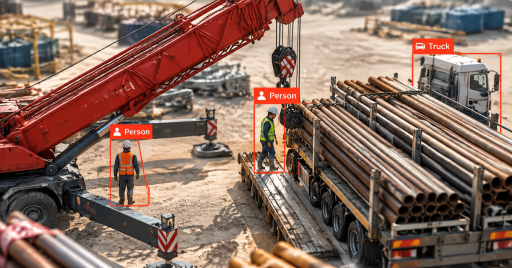
This is where AI-enabled computer vision can provide an additional layer of safety support. By analysing existing CCTV footage, AI systems can continuously observe interactions between personnel, equipment, and operational areas, helping identify potential exposures that may otherwise go unnoticed.
Mustafa Noor, HSE Supervisor at GWDC, sees significant potential for AI based on his experience in workover-rig HSE. He highlighted its ability to identify repeated suspended-load exposures, red-zone violations, and unsafe behaviours during pipe handling, while emphasizing that AI should support HSE professionals rather than replace field supervision, communication, or worker awareness.
The purpose of AI is not to replace HSE professionals, supervisors, or workers. Instead, it is to enhance their ability to identify risks, understand operational patterns, and make better-informed safety decisions.
Brad Stump, highlighted that the potential value of AI extends beyond real-time alerts. He explained that AI can support both planning and operations by learning from previous incidents and recognising risks associated with changing conditions and simultaneous activities: “AI could support both planning and real-time operations by learning from previous incidents and identifying risks related to changing conditions and simultaneous activities.”
In suspended-load operations, this means AI can support safety teams not only by identifying an unsafe situation as it happens, but also by helping them understand why and where similar exposures repeatedly occur.
For example, AI-enabled systems can potentially help identify:
- personnel entering designated red zones during lifting activities,
- workers approaching moving tubulars or handling areas,
- people positioned beneath suspended loads,
- repeated exposure patterns during specific operations or shifts.
However, the real value of AI is not limited to individual alerts. The ability to analyse repeated behaviours and operational trends can help organizations move from simply reacting to incidents toward proactively identifying conditions that may lead to them.
From Real-Time Detection to Safety Intelligence
The greatest value of AI is not only detecting an individual unsafe situation. It is learning from repeated behaviour and helping teams understand whether an apparently isolated exposure is actually part of a wider pattern.
Mohd Aquib Khan highlighted that AI-based monitoring could help identify repeated exposure to red zones, people entering lifting paths, unsafe positioning around tubulars, and recurring deviations from established procedures. Rather than using the technology as a punitive surveillance mechanism, he emphasized its potential as a proactive learning and risk-reduction tool.
For example, if personnel repeatedly enter a red zone during a specific stage of tubular transfer or tripping, AI-generated insights can help HSE and operations teams investigate the underlying reasons. The issue may be related to equipment arrangement, workflow design, communication, procedure design, training, or a behaviour that has gradually become normalized.
This type of operational insight can support more targeted toolbox talks, more effective risk assessments, and interventions focused on actual workplace behaviour rather than assumptions.
Nada Nasser Salim Hamad, Corporate HSE Auditor at Petroleum Development Oman, emphasized that AI should support—not replace—competent supervision and human judgement. Its value depends on reliable detection, appropriate camera coverage, clear governance, worker trust, and using the information for prevention and learning rather than blame.
Building a More Proactive Safety Culture
One of the biggest opportunities of AI is its ability to transform individual experiences and incidents into shared organisational knowledge.
Brad Stump highlighted the challenge that many companies face: valuable safety lessons are often learned locally but are not always shared quickly enough across the industry. He explained: “Sites and companies often face similar hazards without sharing lessons quickly enough. AI could help make safety knowledge more accessible across the industry and prevent others from repeating the same mistakes.”
By combining operational data, near-miss learning, and repeated exposure patterns, AI can help organisations identify emerging risks earlier and share lessons more effectively.
Suspended-load incidents rarely result from a single failure. They usually occur when multiple factors combine, including equipment conditions, human behaviour, communication gaps, environmental conditions, and operational decisions.
Technology alone cannot eliminate these risks. Safe lifting operations will always depend on experienced people, effective procedures, strong leadership, and a proactive safety culture.
However, AI-enabled computer vision can help organizations move from reactive safety management toward proactive risk identification by making unsafe exposure visible before it becomes an incident.
The future of suspended-load prevention is not replacing human experience with technology. It is combining operational expertise with continuous data-driven awareness to create safer drilling environments.
Safety Guidance
For broader industry guidance, see OSHA’s oil and gas drilling guidance and IADC Safety Alerts.
Note: This article combines industry expertise, HSE insights, and responsible use of GenAI tools to explore practical approaches for improving safety through AI-enabled technologies.
Recommended Reads
How Can AI-Enabled HSE Reduce Elevator Line-of-Fire Risks on Drilling Rigs?
Elevator Line-of-Fire risks on drilling rigs are complex because the danger zone is constantly changing. This article explores the main causes of exposure, including human
How Does AI-Enabled HSE Reduce V-Door Risks on Onshore Rigs?
Explore how AI-enabled HSE can help drilling teams uncover hidden V-door risks, detect unsafe behaviors, and strengthen safety culture on onshore rigs.
How AI Can Make Toolbox Talks More Impactful?
Toolbox Talks are essential to HSE routines, but they often lose impact when treated as routine checklists. This article explores how AI-driven tools like the
8 Responses
Spot-on analysis. Technology can map the red zone in real time, but leadership sets the standard for how we respond to the data.
The real power of AI vision on a rig isn’t catching someone in the wrong spot it’s identifying the hidden friction points in our workflows that make people feel they need to take a shortcut. Great reminder that safe lifting isn’t just about rigging integrity it’s about breaking the habit of normalizing line-of-fire exposure.
Thank you, Mahendra. This is a very important point. AI can help make unsafe exposure visible, but the real value comes from understanding why those situations happen in the first place.
As you mentioned, repeated shortcuts and normalized behaviours are often signals of deeper operational challenges — whether related to workflow design, communication, equipment arrangement, or competing priorities.
The goal is not simply to identify people in a red zone, but to help teams understand patterns, remove friction points, and create safer ways of working. Technology can support that journey, but strong leadership and safety culture remain the foundation.
Appreciate you sharing this perspective.
A very important discussion, particularly for drilling operations where suspended loads, line-of-fire exposure and other SIF risks are part of daily work. On a rig, the working environment itself is demanding — long shifts, repetitive activities, harsh conditions and being away from family for extended periods can all add to fatigue and stress.
When people are tired or under pressure, we are all more likely to look for shortcuts or try to finish a job quickly. This is not always about poor safety attitude; sometimes the nature of the work and working environment itself creates that pressure. Research has also highlighted the psychological impact of isolation and separation (Remote work increases isolation and psychological distress, Emanuel, Harrington & Pallais, 2026).
This is where I see an interesting opportunity for AI. In addition to detecting a person entering a red zone or standing in the line of fire, AI-based systems are also being explored for fatigue detection and monitoring (Machine learning assisted human fatigue detection, monitoring, and recovery: A Review). For drilling operations, this could provide another layer of early warning where fatigue may be affecting human performance.
But technology cannot replace Stop Work Authority or leadership. If a driller, supervisor, HSE professional or worker sees an unsafe condition, they should have the confidence to stop the job — whether the cause is a suspended load, fatigue, changing conditions or pressure to get the job done.
The real opportunity is to bring these together: AI for better visibility, effective fatigue management, and leadership that makes Stop Work Authority a practical reality on the rig — not just something written in the procedure.
Thank you, Umer, for bringing the human side of rig operations into this discussion. Your point that shortcuts can reflect fatigue and operational pressure is particularly valuable. Understanding what drives unsafe exposure is essential to preventing it.
Fatigue monitoring is also a worthwhile area to explore, with careful attention to reliability, privacy and worker trust. Any early warning should lead to meaningful support for the crew and action on the underlying pressures.
We fully agree about Stop Work Authority: people need to know that stopping a job will be supported by leadership, even when time is tight. Thank you for adding this perspective to the article.
Excellent article and a very relevant topic for today’s HSE environment.
AI-enabled computer vision can add significant value to suspended-load and red-zone management by identifying unsafe exposure and, more importantly, revealing repeated patterns before they lead to an incident.
However, technology should complement—not replace—strong fundamentals: effective risk assessment, competent supervision, proper lifting plans, exclusion-zone discipline, and Stop Work Authority.
The real opportunity is to combine human experience + strong safety culture + AI-driven safety intelligence to move from reactive safety management toward proactive prevention.
AI can detect the exposure, but leadership and safety culture must eliminate the conditions that create it.
Thank you for reading and sharing such a thoughtful perspective. Your point about addressing the conditions behind unsafe exposure is especially important. Detecting a repeated pattern is only valuable when it leads to action—reviewing how work is planned, listening to crews, and ensuring people feel empowered to stop an unsafe operation.
At Veunex, we see AI’s role as helping teams turn everyday observations into practical improvements, supported by the experience and leadership of the people on site. Thank you for adding this valuable perspective to the discussion.
A very interesting perspective. From an HSE and operational-risk point of view, I see AI-enabled computer vision as a valuable additional layer of control, but not a replacement for the fundamental controls of suspended-load management.
One point I would add is that detecting a red-zone violation is not the same as controlling the risk. The real value comes from what happens after detection: immediate intervention, stop-work where necessary, investigation of the underlying causes, and using the data to improve the work process.
I would also be careful not to classify repeated red-zone entry automatically as a behavioural issue. If the same exposure occurs repeatedly, we should ask whether the task design, equipment layout, SIMOPS, procedure, access arrangements or operational constraints are creating the condition.
This is where I see a strong opportunity for AI: not only detecting “a person is in the red zone”, but identifying recurring exposure patterns and their relationship with specific operations and SIMOPS.
The objective should ultimately be to move from:
incident → investigation → corrective action
toward:
exposure → pattern recognition → intervention → prevention.
AI should enhance HSE professionals’ field presence and decision-making—not replace competent supervision, engineering controls, or operational leadership.
Thank you for your insightful contribution, Hamza. You’ve hit on a critical point: AI is a powerful tool for pattern recognition and proactive intervention, but it must complement, not replace, robust engineering controls and competent supervision. Your perspective on moving from incident investigation to exposure prevention perfectly aligns with the future of HSE.